.png)
Why Singapore Food Factories Will Be the Most Sought-After Industrial Asset of the Decade

Published: 16 June 2026 | By Marc Singh, Associate Division Director, ERA Singapore
There is a conversation happening quietly among Singapore's more astute property investors right now - and it is not about condominiums, office strata, or shophouses. It is about food factories. Specifically, about whether the structural tailwinds behind this niche industrial asset class are strong enough, and durable enough, to justify serious capital allocation.
My view, having spent decades in Singapore's commercial and industrial property market: they are. And I would go further. I believe food factories are entering a phase of demand that is not cyclical but structural - driven by government policy, demographic reality, and a permanent shift in how Singapore thinks about food production and supply chain resilience. End-users are not going away. If anything, they are multiplying. And when end-user demand is this deeply rooted, investor returns follow.
This article sets out why I hold that view, what the data says, and why one development in particular - Gourmet Xchange at Kallang Way - is, in my opinion, the standout food factory investment available in Singapore today.

The Sector Is Genuinely Growing
Let us start with the supply side of the industry itself. The Singapore Business Review reported that the number of food processing and manufacturing firms in Singapore increased by 8 per cent, a figure that reflects both rising entrepreneurial activity in the food sector and the ongoing formalisation of food preparation operations that previously flew under the radar. Central kitchens, cloud kitchens, ready-to-eat producers, specialty food manufacturers - the category of operators who need dedicated, regulation-compliant food production space is broadening.
The broader market data reinforces this. Singapore's food processing market is projected to grow at a compound annual growth rate of 10.1 per cent through to 2029, according to industry research. Meanwhile, Singapore's overall manufacturing sector expanded 5.2 per cent year-on-year in the second quarter of 2025. These are not soft projections built on hope. They reflect capital commitments already made, operations already scaled, and food businesses that have already outgrown informal arrangements and need purpose-built infrastructure.
The question for investors is not whether this demand exists. It demonstrably does. The question is whether the supply of good food factory space can meet it - and whether the best units will remain available at current prices.
Government Policy Has Made This a Structural Story
One of the most reliable signals that long-term demand for food factories is secure is the degree to which the Singapore government has made food production a national priority.
Singapore's food security goals - which include producing 20 per cent of the city's fibre consumption needs and 30 per cent of its eggs and seafood consumption locally by 2035 - require a physical infrastructure backbone. That backbone is food factories. You cannot scale local food production without scaled local food production facilities. Government ambition, in this case, translates directly into end-user demand for industrial food space.
This is not abstract policy. Enterprise Singapore followed through in October 2025 with concrete initiatives designed to help 1,000 food and beverage businesses reduce costs through centralised food preparation. The FoodX Programme was launched to match F&B companies with suitable contract manufacturers from a network of over 60 food manufacturing and equipment partners. The explicit goal is to push F&B operators toward formal, centralised, more efficient food manufacturing arrangements - which means more operators needing food factory space, not fewer.
JTC is expanding food-dedicated infrastructure with new developments such as Bedok Food City. The URA Master Plan continues to designate specific industrial zones for food-related trades. The architecture of government support is not temporary; it is being built into Singapore's long-term planning frameworks.
When government policy, national security priorities, and industrial land planning all point in the same direction, investors should pay attention.
Supply Is Tighter Than Most People Realise
Here is where the investment argument sharpens considerably. According to JLL's February 2026 research report on Singapore's strata food factory segment, there are close to 1,200 completed strata food factory units across the island as of the fourth quarter of 2025. By 2028, the total island-wide stock is projected to grow to just over 1,700 units - an increase of approximately 500 units over roughly three years.
To put that in context: Enterprise Singapore is targeting 1,000 F&B businesses alone for its centralised preparation programme. Even accounting for businesses that lease rather than own, the ratio of growing operators to available purpose-built strata units is structurally tight. Not every operator will want or need to own a unit, but those who do will find options genuinely limited.
JLL also noted that the 349 units completed in 2025 - the largest single-year supply addition in recent memory - temporarily intensified competition for tenants. But the report's overall conclusion was clear: the outlook for this niche sector remains promising, and future demand prospects appear sound. That is a measured, data-driven assessment from one of the world's leading property consultancies, not promotional copy.
On the price side, Singapore's industrial property market recorded firm growth in the first quarter of 2026, with values rising for the eighth consecutive quarter - up 1.2 per cent quarter-on-quarter. JTC reported overall industrial occupancy at 88.9 per cent in early 2026. This is a stable, supply-constrained market with pricing power - exactly what long-term investors want to own into.
End-Users Are the Anchor: This Is Not Speculative Demand
One thing that distinguishes food factory demand from other industrial sub-sectors is the nature of the end-user. A food manufacturer, central kitchen operator, or catering company does not occupy a food factory the way a logistics tenant occupies a warehouse. They invest heavily in the space: ventilation systems, cold rooms, food-grade flooring, grease traps, hygiene fit-outs. The cost and disruption of relocation is high. This makes food factory tenants - and owner-occupiers - structurally sticky in ways that translate directly into investor stability.
Beyond stickiness, the categories of demand are multiplying. Cloud kitchens and delivery-first F&B brands need commissary space. Traditional restaurant chains expanding into manufacturing need production capacity. Plant-based food startups need food-grade R&D and processing environments. Ready-to-eat meal producers need high-throughput, temperature-controlled facilities. Each of these operator types is growing in Singapore, and each of them needs exactly what a well-specified food factory provides.
The move toward centralised food preparation - actively encouraged by Enterprise Singapore - also creates a new category of demand: F&B businesses that historically prepared food on-site at their restaurants or retail outlets, now outsourcing production to dedicated facilities. This is a one-way shift. Once a business has restructured its operations around centralised production, it does not reverse that decision. The infrastructure requirement becomes permanent.
The Investor Case: Yields, Tax Efficiency, and Appreciation
Beyond the structural demand story, the financial mechanics of food factory investment in Singapore are compelling on their own terms.
Industrial properties in Singapore attract zero Additional Buyer's Stamp Duty for individual purchasers. At a time when residential second-property ABSD runs from 20 per cent to 60 per cent depending on residency status, this is a material structural advantage. Capital that would otherwise be lost to stamp duty works in the asset instead.
Industrial rental yields are commonly cited in the mid-single-digit range - meaningfully above the 2 to 3 per cent typical of residential property in the current market. Food factory tenants, for the reasons discussed above, tend toward longer lease commitments and less frequent vacancy events, which supports the realisation of those headline yields rather than eroding them through voids.
And capital values are moving. Eight consecutive quarters of industrial price growth is not noise; it is signal.
Why Gourmet Xchange Stands Apart
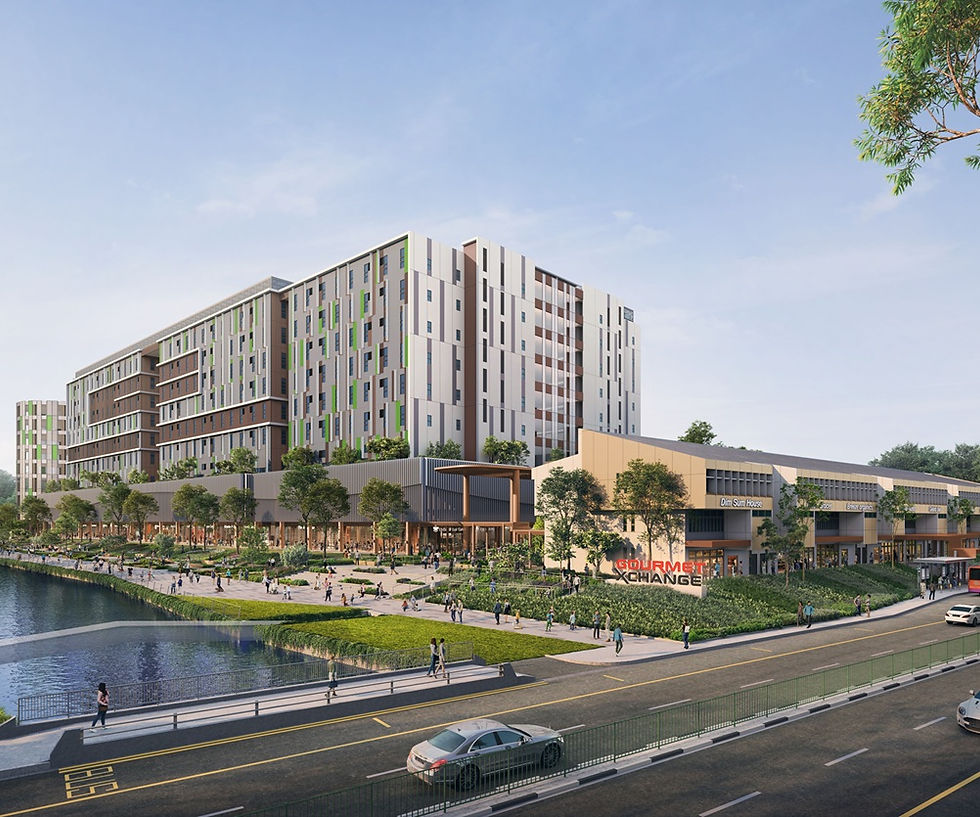
Given everything above, the remaining question for a serious investor is which food factory to buy. And here, I will be direct: in my assessment, Gourmet Xchange at Kallang Way is not just the best food factory available in Singapore right now - it is in a different category from its peers.
JLL's February 2026 research specifically identified Gourmet Xchange as the largest upcoming strata food factory development in Singapore, with the remainder of the new supply pipeline spread across much smaller projects of under 100 units each. Scale matters in this segment: a larger development supports a more diverse tenant mix, a stronger community of food operators, and better long-term liquidity for investors when they choose to exit.

But Gourmet Xchange's case is not just about size. Several features distinguish it from every other food factory development currently in the pipeline.
CapitaLand as developer. Developed by CL Savour Property Pte Ltd, a subsidiary of CapitaLand Development, Gourmet Xchange carries the design and delivery standards of one of Asia's most respected real estate groups. Build quality, project management, and long-term asset management are not afterthoughts - they are CapitaLand's institutional obligation.
Purpose-built, not converted. The nine-storey B2 food manufacturing tower - The Xchange - is designed from the ground up for food production. Seven-metre ceiling heights, 40-footer and 24-footer truck ramp-up access, high floor-loading for heavy machinery including mixers, blast freezers, and automated packaging lines. These are not features retrofitted into a generic industrial shell; they are built into the structural DNA of the building.
A one-of-a-kind heritage component. Gourmet Xchange incorporates the adaptive reuse of Block A, Singapore's last remaining three-storey Terrace-Showroom factory cluster from the 1980s. Originally built by JTC, with distinctive gable-end walls and protruding solar fins, it is preserved and repurposed as the Heritage Terrace - offering a vertically integrated produce, brand, and sell concept that no other food factory in Singapore can replicate.
Prime location within the Kallang River Masterplan. Gourmet Xchange sits within the URA's Kallang River Masterplan, which envisions a revitalised waterfront corridor of approximately three kilometres with community nodes and public spaces. The development is designed as an amenity node - with a central plaza, river promenade, sky garden, and F&B zones - giving it the kind of destination quality that typical industrial estates simply do not have. This matters for tenant attraction and for the longer-term capital value story as the Kallang precinct continues to develop.

Green Mark Platinum SLE certification. Environmental credentials are no longer a marketing addition; they are increasingly a requirement for institutional tenants, corporate occupiers, and ESG-conscious investors. Gourmet Xchange's Green Mark Platinum SLE status positions it ahead of the ageing food factory stock it will compete against for tenants.
Singapore's largest strata food hub. With 264 production units - the largest purpose-built strata-titled food manufacturing development on the island - Gourmet Xchange offers a diversity of unit sizes and configurations that allows operators at different stages of growth to find the right fit, and investors to select the right unit profile for their return objectives.
A Final Thought
Food factory investment in Singapore sits at the intersection of three powerful, converging forces: an irreversible policy mandate around food security, a structural broadening of the food operator base, and a supply pipeline that cannot keep pace with demand without concentration in a small number of large-scale developments.
Investors who recognise that food factories are not a niche curiosity but a fundamental piece of Singapore's economic infrastructure - and who choose the right development within that sector - are, in my view, positioning themselves in front of a long-duration tailwind.
Gourmet Xchange is that development. Nothing else in the current pipeline comes close on scale, specification, location, or developer pedigree. For end-users who need the space to run and grow their food business, it is the most capable facility being built in Singapore. For investors who want to own what end-users will pay to be in, the argument makes itself.
To find out more about Gourmet Xchange at Kallang Way, visit gourmetxchange.co.
Marc Singh is an Associate Division Director at ERA Singapore (CEA Reg. No. R043047E) specialising in commercial and industrial properties, with over 30 years of experience in the Singapore property market.

Comments