.png)
When Big Names Pull Back, Smart Investors Move In: The Food Factory Opportunity You Shouldn't Ignore

In early 2026, a Channel NewsAsia report sent ripples through Singapore's food industry: Yeo Hiap Seng — better known as Yeo's — had laid off 25 workers after shifting all can manufacturing to Malaysia, while Asia Pacific Breweries (APB) Singapore announced that 130 jobs would be affected as it scales down local brewing operations by end-2027. The headlines were alarming. The narrative was easy to construct: Singapore is too expensive, food manufacturing is leaving, industrial property is under threat.
My view? The opposite is true. These headline events are symptoms of a healthy and overdue restructuring — and for investors who understand the nuance, they are a signal to pay closer attention to Singapore's food factory property market, not walk away from it.
Reading Beyond the Headlines
Both Yeo's and APB are relocating high-volume, price-sensitive production to Malaysia — not shutting down entirely. Logistics, innovation, and management functions remain in Singapore. This is not an exit. It is a business optimisation. When a company strips out the low-margin, labour-intensive work and retains the high-value functions, that is not a sign of failure. That is strategic maturity.
Here is what the CNA article also made clear: Singapore's food manufacturing sector as a whole exceeded a projection of 2,500 higher value-added jobs from 2022 to 2025, according to Enterprise Singapore. In 2024, the sector employed around 68,000 workers, contributed S$6.8 billion to GDP, and counted over 1,500 companies operating across food and beverage categories. The sector is not shrinking. It is upgrading.

The Structural Case for Industrial Property Has Never Been Stronger
Singapore's industrial property market has long been misunderstood. It lacks the glamour of residential real estate and the visibility of prime retail — but the fundamental drivers are structural, not cyclical: land scarcity, JTC's disciplined supply management, no ABSD for foreigners, and stable tenant profiles.
What the CNA story reinforces is that Singapore is becoming a hub for higher-value food activities — R&D, product development, quality assurance, regional management, and innovation. These functions need proper infrastructure. A startup testing a new sauce formulation, a regional FMCG company setting up its Asia innovation centre, or a catering group scaling its operations — all of them need the kind of purpose-built food production space that Singapore's food factory ecosystem continues to supply.
Food Factories as an Investment Asset: Why the Thesis Is Intact
The reason food factory investment is compelling is precisely because it is misunderstood by the mainstream. The investor psychology behind food factory demand has always been about utility, scarcity, and operational relevance — not glamour. A tenant who installs drainage, achieves NEA compliance, trains staff, and builds supplier relationships into a unit is not going to move out at the first sign of a market wobble. That stickiness is exactly what sophisticated investors value.
As Singapore's food sector shifts toward higher-value activities, the demand profile for food production space also upgrades with it. The businesses moving in are not low-margin volume producers. They are innovation hubs, regional headquarters, and premium food brands — operators for whom the future of F&B depends more on production space than storefronts. These tenants are willing to pay for quality, compliance, and location — and they sign leases that reflect their commitment.

The Singapore Government Is Your Biggest Ally as an Investor
The CNA article also makes clear that EnterpriseSG is actively supporting the sector's transition — funding digitalisation, job redesign, and skills upgrading. This is not the behaviour of a government retreating from food manufacturing. This is a government engineering a deliberate upgrade. Singapore's 30 by 30 food security agenda and its broader food resilience push mean that industrial land zoned for food production will remain in sustained demand — and the supply of purpose-built food facilities will remain constrained.
For investors, this combination of government-backed demand, constrained supply, and improving tenant quality is as strong a foundation as you will find in any real estate asset class in Singapore. The Singapore government's role in attracting industrial investment is one of the most underappreciated factors in the long-term investment thesis.
Why Gourmet Xchange Is the Absolutely Best Choice for Investors and End-Users
If you accept the thesis — that Singapore's food production space is evolving upward, not disappearing — then the next question is simple: where do you want to be positioned? My answer, without hesitation, is Gourmet Xchange.
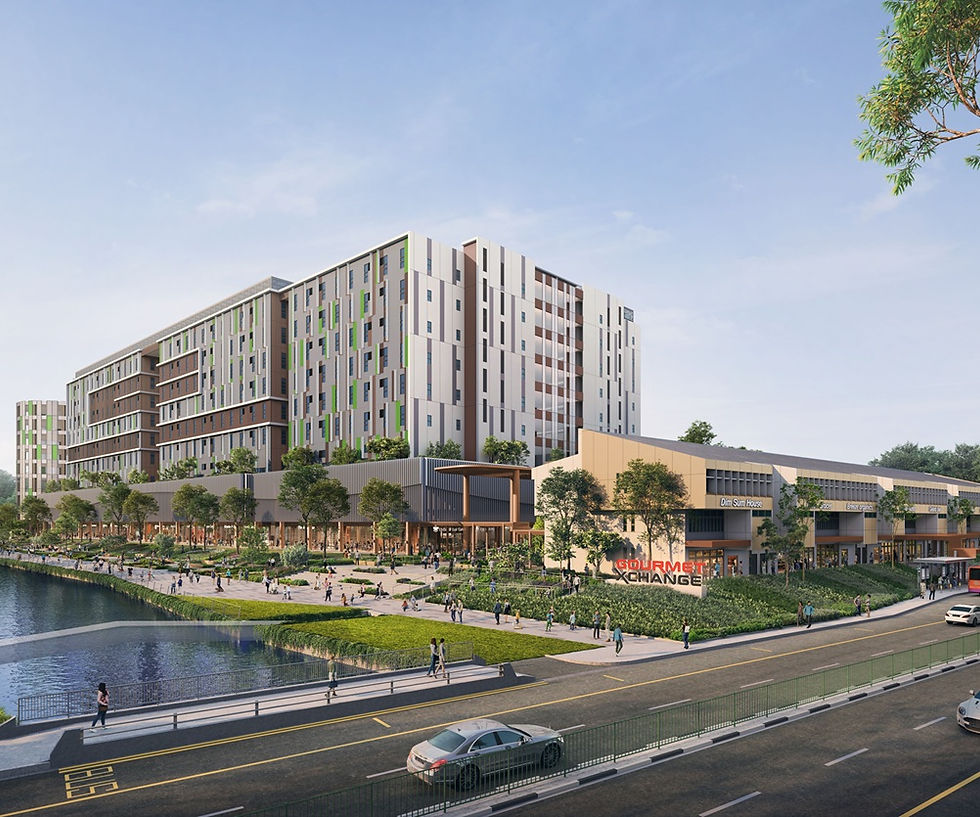
Developed by CapitaLand Development — one of Singapore's most trusted institutional names — Gourmet Xchange is Singapore's largest strata-titled food development, located along the Kallang River in the heart of the island. It is purpose-built for the exact kind of operators the CNA article describes — those doing R&D, product innovation, central kitchen operations, and high-value food production. Kallang's strategic location means operators here can reach customers faster — a structural advantage in a delivery-driven economy.

For investors, Gourmet Xchange ticks every box: strata title ownership (you own the unit outright), ramp-up access for heavy loading, B2 industrial zoning that supports the full range of food-related uses, and CapitaLand's developer credibility that makes the development easier to finance, manage, and eventually exit. Gourmet Xchange is not just selling space — it is selling an ecosystem.
For end-users — whether you are a food manufacturer, caterer, central kitchen operator, FMCG brand, or F&B group looking to consolidate production — Gourmet Xchange offers something rare in Singapore: a food facility purpose-built for the next generation of food businesses. Not a converted flatted factory. Not a legacy estate with outdated infrastructure. A brand-new, waterfront development designed around the operational needs of modern food operators — with the regulatory credibility, central location, and community that makes growing a food business in Singapore genuinely viable.

The Long View
Every industry has moments that look like contraction but are actually transformation. Singapore's food manufacturing sector is in one of those moments right now. The companies pulling back are those whose volume model no longer fits Singapore's cost structure. The companies staying — and the new ones arriving — are building something different: higher-value, more innovative, more globally connected food businesses. That is exactly the kind of tenant you want in your food factory. That is exactly the kind of industry you want to invest alongside.
If you are an investor or end-user looking for the right food factory in Singapore, Gourmet Xchange is where the smart money is heading. Get in touch to find out more.
Reference: "Why some food manufacturers stay in Singapore even as costs push production abroad", Channel NewsAsia, 30 April 2026. Data references: EnterpriseSG, JTC, ERA Research and Market Intelligence.


Comments