.png)
Why a ‘Godzilla’ El Niño Could Drive Demand for Singapore’s Food Factories

Scientists are warning that a ‘Godzilla-like’ El Niño is building in the Pacific, expected to peak this September. The World Meteorological Organization says it could be the strongest El Niño on record: bringing droughts across Asia and southern Africa, flooding in parts of the Americas, and significant disruption to global food supply chains.
For anyone in food manufacturing or industrial property, the headlines read like a crisis. But the picture is more nuanced than it first appears. El Niño-driven food supply disruptions don’t just shrink supply; they also redirect demand. And some of that demand lands in an unexpected place: food factories.
Here are the reasons why.

A ‘Godzilla-like’ El Niño could trigger economic and political disruption worldwide. Photo: Ricardo Ribas/Alamy Stock Photo.
1. Food Supply Disruptions Make Imports Expensive — and Unreliable
El Niño is expected to weaken the Indian monsoon, suppress grain production across key agricultural regions, and amplify existing supply chain pressures. Fertiliser supply is already under strain: the closure of the Strait of Hormuz has disrupted the transport of almost a third of the world’s fertiliser, pushing input costs higher for farmers already operating on tight margins.
Dr Mike Rivington of The James Hutton Institute, which researches food production, put it plainly: ‘Every time you get a shock or an extreme weather event, it makes you less resilient for the next one. We’re having to run faster and faster to stand still with food production.’
The historical record makes the risk concrete. During the powerful 2015–2016 El Niño, South Africa experienced one of its worst droughts in decades. Maize harvests collapsed, the country was forced to import millions of tonnes of grain at significantly elevated cost, and food prices spiked sharply across the region.
When food imports become unreliable and expensive, the economics of local food production improve. Food operators who previously relied on imported ingredients or finished goods start reassessing their dependence on global supply chains. Many look seriously, often for the first time, at building or leasing local food factory space.

El Niño brought a severe drought to Colombia in 2016. Photo: John Vizcaino/Reuters.
That shift in thinking translates directly into demand for food factory space.
2. Singapore’s Food Security Agenda Gets a New Sense of Urgency
Singapore already imports over 90 per cent of its food. The government’s 30 by 30 goal — producing 30 per cent of the country’s nutritional needs locally by 2030 — was already a policy priority before El Niño entered the conversation.
But every time a global food shock makes international headlines, the urgency of that agenda intensifies. El Niño puts pressure on exactly the food systems Singapore depends on: Southeast Asian agricultural output, Australian grain and livestock exports, and global commodity markets that underpin food pricing in Singapore supermarkets.
The more unpredictable those external systems become, the more valuable it is to have resilient local production capacity. That means more food manufacturers looking for production space in Singapore, more government support for food security investment, and more operators building or upgrading local facilities. Singapore’s booming food factory sector follows that logic directly.
3. Supply Chain Diversification Is Becoming a Business Necessity
The years following COVID-19 taught food businesses a painful lesson about single-source supply chains. El Niño is another chapter in the same story, adding climate risk to the geopolitical and logistical shocks that have already reshaped procurement decisions across the industry.
Food operators relying entirely on imported ingredients and finished goods face two risks simultaneously: disruption to supply, and volatility in pricing. A local food factory or central kitchen reduces both. You control the output, the timing, and to a meaningful degree, the cost base.

Flash floods in Kenya in April 2024. Photo: LUIS TATO/AFP.
For multinational food brands and large F&B operators with Singapore operations, this is increasingly not just a nice-to-have: it’s a risk management decision. When the next weather shock hits — and there will always be a next one — having a local kitchen or processing facility means you keep operating while competitors scramble. The difference between a ramp-up food factory and a flatted factory becomes very clear in moments like these.
4. Demand for Processed and Shelf-Stable Foods Rises During Uncertainty
This one often gets overlooked. When food prices are volatile and supply chains are uncertain, both governments and consumers tend to stockpile. The products that get stockpiled are overwhelmingly processed, packaged, and shelf-stable: canned goods, condiments, dried grains, sauces, ready-to-eat meals.
That is food manufacturing output. And the future of F&B increasingly depends more on production space than storefronts. Local producers who can supply shelf-stable products efficiently benefit directly from this shift in demand — and they need purpose-built food factory space to do it at scale.
If you’re a food operator or investor watching these trends, the direction is clear. The case for Singapore’s food factory sector has always been strong on fundamentals. As I explored in detail recently, smart investors are already moving into Singapore’s food factory space precisely because the long-term demand drivers are structural, not cyclical. What climate disruption does is accelerate the timeline.
Why Gourmet Xchange Is Positioned to Capture This Demand
If you accept the thesis — that Singapore’s need for local food production capacity is only going to grow — then the next question is simple: where do you want to be positioned? My answer, without hesitation, is Gourmet Xchange.
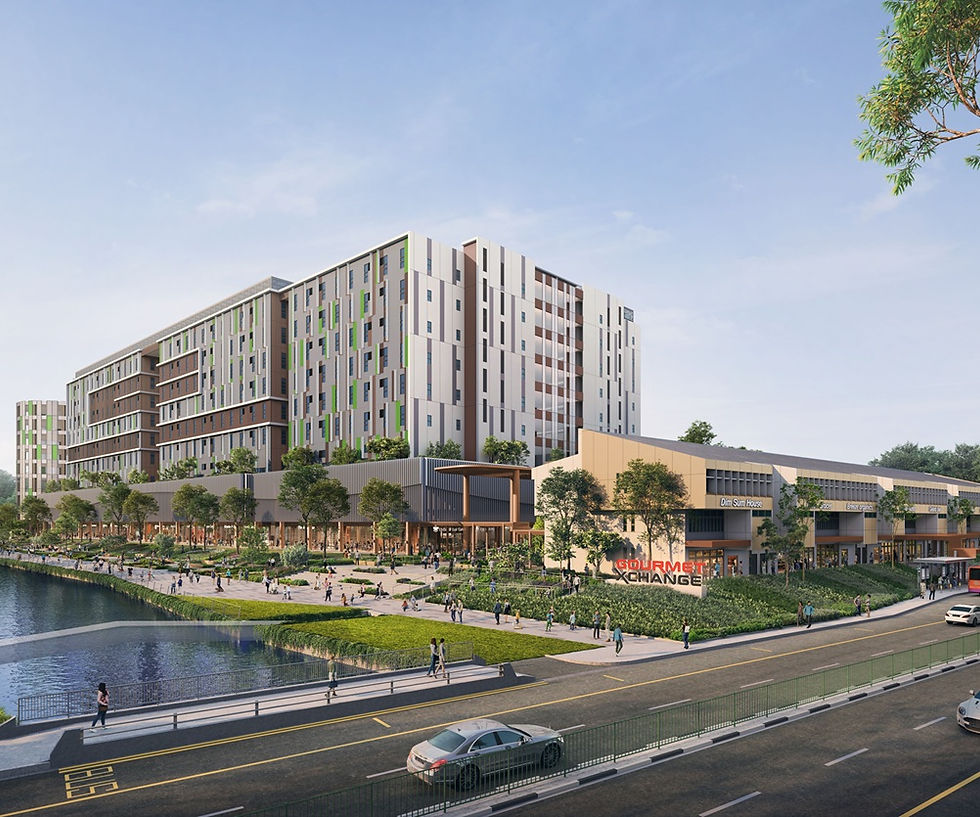
Developed by CapitaLand Development — one of Singapore’s most trusted institutional names — Gourmet Xchange is Singapore’s largest strata-titled food factory development, located along the Kallang River in the heart of the island. It is purpose-built for exactly the kind of operators this environment will produce: food manufacturers, central kitchen operators, FMCG brands, and F&B groups looking to consolidate production capacity close to the city. Kallang’s strategic location for food production and distribution means operators here can reach customers faster — a structural advantage in a delivery-driven economy.

An aerial view of Gourmet Xchange — Singapore’s largest strata-titled food factory development, along the Kallang River.
For investors, Gourmet Xchange ticks every box: strata title ownership (you own the unit outright), ramp-up access for heavy loading, B2 industrial zoning that supports the full range of food-related uses, and CapitaLand’s developer credibility that makes the development easier to finance, manage, and eventually exit. Gourmet Xchange is not just selling space — it is selling an ecosystem.
For end-users — whether you are a food manufacturer, caterer, central kitchen operator, FMCG brand, or F&B group looking to consolidate production — Gourmet Xchange offers something rare in Singapore: a food facility purpose-built for the next generation of food businesses. Not a converted flatted factory. Not a legacy estate with outdated infrastructure. A brand-new, waterfront development designed around the operational needs of modern food operators — with the regulatory credibility, central location, and community that makes growing a food business in Singapore genuinely viable.

The river promenade at Gourmet Xchange — a waterfront food development purpose-built for Singapore’s next generation of food businesses.
The climate pressures that are reshaping global food supply chains are, paradoxically, strengthening the case for exactly the kind of asset Gourmet Xchange represents. If you are an investor or end-user looking for the right food factory in Singapore, get in touch to find out more.
Source: Lilia Sebouai, ‘How a Godzilla El Niño could plunge the world into irreversible chaos’, The Telegraph, 11 June 2026.


Comments